Drawing on nationally representative data from two waves of the India Human Development Survey, this paper examines how family structures, functional health, work participation, and state support interact to shape the well-being of Indians aged 60 and above. We document a gradual decline in intergenerational co-residence, alongside rising proportions of older adults
living alone or only with a spouse. While family remains the primary source of care and income support, the role of the state has significantly expanded through pensions and health insurance schemes. We argue that the emerging landscape of ageing in India rests on a shifting “trinity” of support—family, self, and the state—each of which must adapt to demographic and gender transformations to ensure secure and dignified ageing.
Using data from a primary survey conducted in rural India, this paper examines how two key survey design features—respondent identity and question framing—affect employment estimates. First, it estimates the causal impact of (a) replacing a single weekly employment question with a set of detailed activity-specific questions, and (b) changing the reference period from a week to individual days. The detailed module yields significantly higher estimates of women’s employment with no corresponding effect for men. Second, using spousal respondent pairs, the paper finds that proxy-reports by men significantly underestimate women’s employment while men’s employment estimates do not differ between self- and proxy- reports. Within different types of employment however there are significant deviations for both genders. Intra-household analysis suggests misreporting is driven by asymmetric information and gender norms. Overall, the findings underscore the importance of self-reporting and detailed questions for accurately measuring employment with implications for improving survey design in resource-constrained contexts.
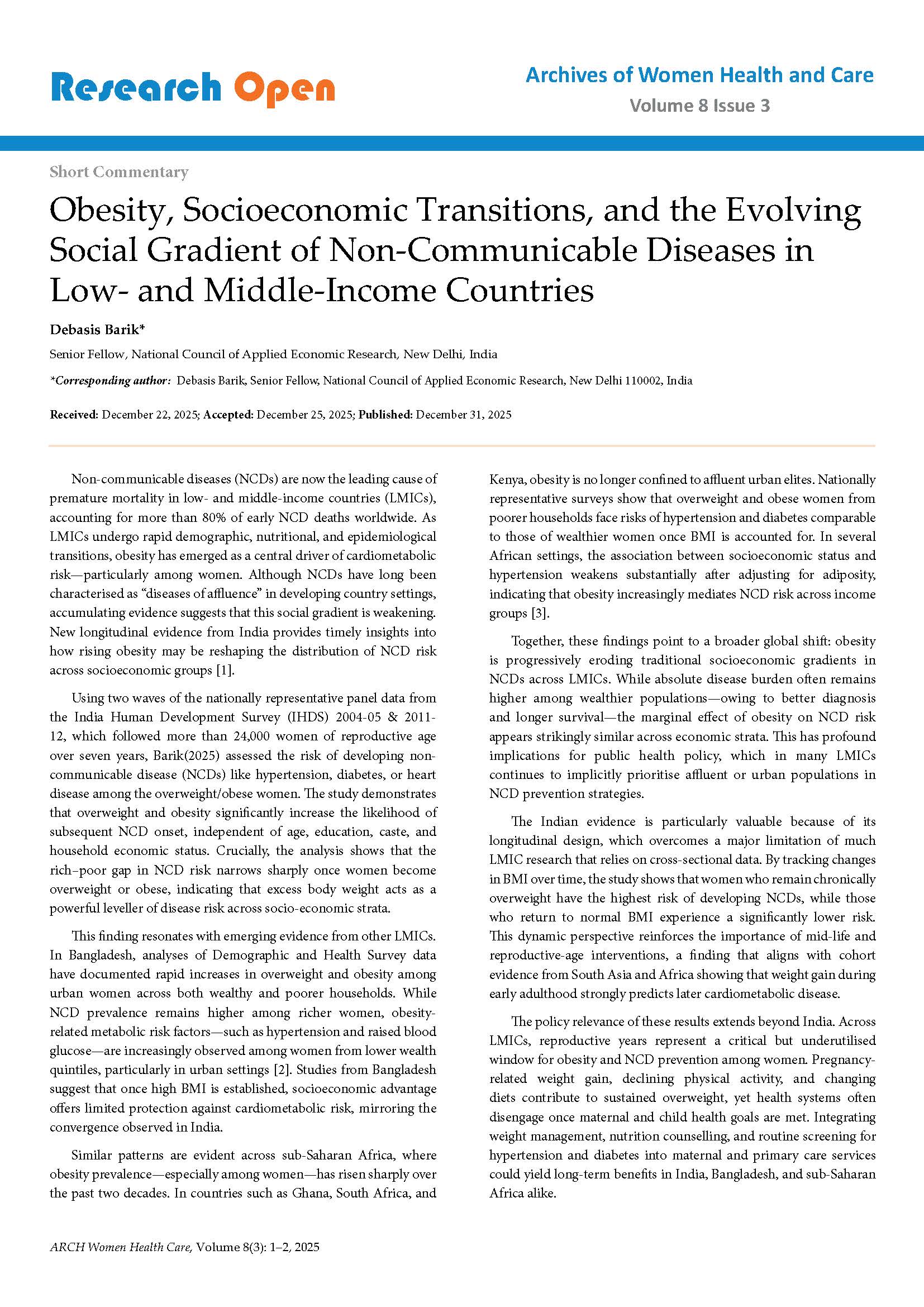
Non-communicable diseases (NCDs) are now the leading cause of premature mortality in low- and middle-income countries (LMICs), accounting for more than 80% of early NCD deaths worldwide. As LMICs undergo rapid demographic, nutritional, and epidemiological transitions, obesity has emerged as a central driver of cardiometabolic risk—particularly among women. Although NCDs have long been characterised as “diseases of affiuence” in developing country settings, accumulating evidence suggests that this social gradient is weakening. New longitudinal evidence from India provides timely insights into how rising obesity may be reshaping the distribution of NCD risk across socioeconomic groups.
Using two waves of the nationally representative panel data from the India Human Development Survey (IHDS) 2004-05 & 2011- 12, which followed more than 24,000 women of reproductive age over seven years, Barik(2025) assessed the risk of developing non- communicable disease (NCDs) like hypertension, diabetes, or heart disease among the overweight/obese women. The study demonstrates that overweight and obesity significantly increase the likelihood of subsequent NCD onset, independent of age, education, caste, and household economic status. Crucially, the analysis shows that the rich–poor gap in NCD risk narrows sharply once women become overweight or obese, indicating that excess body weight acts as a powerful leveller of disease risk across socio-economic strata.
Internal migration of labor (or labor migration) from rural to urban areas was once thought to be a necessary process to meet labor demand at the urban industrial sectors. The classical two-sector migration models assumed that people migrate from less remunerative agricultural sector to the urban industrial sector, where expected rate of labor return was higher (Lewis, 1954; Ranis & Fei, 1961). This process was considered beneficial, since labor force was being shifted from the locations where their marginal productivities were assumed to be zero to the places where they turned not only positive but also were growing rapidly as a result of capital accumulation and technological advancement. These migration models were developed largely in the context of advanced industrial economies where the existence of the full or near-full employment in urban areas were assumed implicitly. The validity of these models starts underperforming once the rural to urban migration rate exceeds the rate of urban job creation. This makes the classical two-sector migration models irrelevant in the context of developing countries, where there remains surplus labor even in the urban centers (Harris & Todaro, 1970; Todaro, 1968, 1969, 1976, 1996). Internal migration in developing countries is often characterized by over-crowding of semi-skilled or unskilled rural labor migrants in the urban work place. Though expected wage rate in the urban is higher than the rural areas, probability of securing a high-paid urban job is much less among the new entrants. Consequently, they either take up casual or part-time jobs or remain unemployed for sometimes (Todaro, 1980).
The National Family Health Survey has consistently documented a sharp rise in overweight and obesity among Indian adults. Among women of reproductive age, the prevalence of obesity has nearly doubled in the past 15 years—from 12.6 per cent in 2005–2006 to 24.0 per cent in 2019–2021. The existing literature highlights a strong association between household economic status and the incidence of non-communicable diseases (NCDs) such as hypertension, diabetes and heart disease. However, the growing burden of overweight and obesity elevates NCD risk even among economically disadvantaged groups. Evidence from developing countries remains limited, partly because NCDs develop gradually and their links with obesity are difficult to establish using cross-sectional data. Drawing on a panel of 24,547 women aged 15–49 years, this study examines the risk of developing NCDs among overweight and obese women in India. Multivariate logistic regression models were employed to identify the correlates of NCD onset, and robustness checks were performed to assess how changes in obesity status influenced disease risk. The findings reveal that while wealthier women face a higher overall risk of developing NCDs, this risk is also shaped by the body mass index (BMI) status of women. Importantly, the rich–poor gap in NCD prevalence diminishes once women become overweight or obese. Although much of the existing literature emphasises the role of socio-economic and demographic factors in NCD development, this study suggests that their influence may be substantially offset by lifestyle and health behaviour modifications that help in maintaining a healthy BMI among reproductive-age women.