


 NCAER - NATIONAL DATA INNOVATION CENTRE
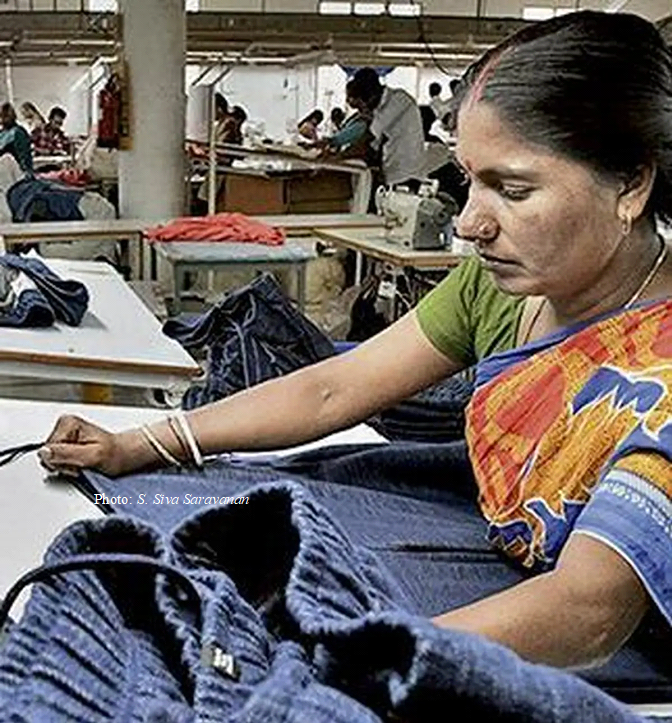
Schemes to raise women’s workforce participation will come a cropper unless men actively take part in domestic work.
Even as policy efforts are being oriented towards ‘Viksit Bharat 2047’through women-led development, a large chunk of women in India remains absent from paid employment, a reality that undermines both gender equality and economic growth. Over the past two decades, some initiatives like skill development programmes, entrepreneurship support, investment in child care, and flexible work arrangements have sought to raise women’s participation in paid employment. Yet, these measures have not yielded the desired results.
Currently, only about a third of Indian women participate in the labour force, far below most developed economies and roughly half of the levels in Scandinavian countries. It is even lower than several lower-middle-income countries like Bangladesh. This persistent gap reflects a deeper, structural inequity. Women are encouraged to enter paid employment without a corresponding reduction in their unpaid domestic and care work that consumes much of their day. Without addressing this imbalance, the gains from these policies will remain limited.
Data points
The National Statistical Office’s Time Use Survey (2024) makes this im-balance visible. Among young adults aged 15–29 years, women spend over five hours a day on unpaid domestic and care work, while men spend just half an hour. Absence of women from the labour market, therefore, often reflects not inactivity but their engagement in unpaid work. Men, meanwhile, devote roughly four and a half hours daily to paid employment. In contrast, Scandinavian countries, where domestic work is shared more evenly with men spending three or more hours a day on housework, consistently record higher and more stable female labour force participation.
Policy debates on women’s employment often focus on labour-market and public-sphere barriers – limited job availability, safety and mobility concerns, and mismatches between education, skills, and job opportunities. These constraints are indeed real and deserve attention. But ad-dressing them in isolation assumes that women can endlessly stretch their time to combine the existing domestic and care burden with paid work. For most women, most of the day is already earmarked for unpaid domestic and care work. Policies centred solely on employability or job creation ask women to squeeze in paid work into days that are already full, resulting in time poverty.
Unsurprisingly, many respond by opting out of the workforce or cluster-ing in home-based, informal, or part-time jobs that accommodate domestic responsibilities but offer limited security or advancement. When unpaid work remains unequally distributed within households, investments in skills, childcare, and employment generation struggle to trans-late into sustained workforce participation.
Sharing domestic work
The picture would change only when men share domestic responsibilities more equally; women would then gain the time and energy to effectively engage in paid work, amplifying the impact of labour-market interventions. But the issue is far more complex than what it appears to be.
This unequal allocation of domestic and care work does not emerge overnight. It is shaped early in life through gender socialisation. Girls spend their formative years learning household responsibilities, care giving, and emotional labour, while boys are more likely to invest time in market-oriented skills -uninterrupted study, sports, networking, and training. These early differences shape confidence, mobility, and expectations around work. By the time young adults enter the labour market, many women are already burdened with substantial unpaid household and care work that constrains their choices.
Change in culture
A life-cycle approach is therefore essential. It requires a fresh look at gendered division of labour and since it is learned early, it must also be addressed early. Life-skill education should explicitly include household and care work for both boys and girls, recognising cooking, cleaning, and care giving as essential skills for everyday life rather than women’s responsibilities alone. Embedding these skills within school curricula can help normalise men’s participation in domestic work long before adult-hood. Public investment must also extend beyond childcare to a broader care infrastructure to include even the elderly.
While schemes such as ‘Palna’ have strengthened crèche facilities, their reach remains too limited. As India’s population ages, need for elderly care will further intensify women’s unpaid care work burden unless it is addressed through expanded public and community-based services.
Importantly, this is not merely a cultural argument but an economic one. Countries that have successfully narrowed gender gaps in employment, particularly Scandinavian nations, had combined labour-market reforms with policies that actively encourage men’s engagement in care work through parental leave, workplace norms, and sustained public messaging that frames domestic responsibility as shared work. India’s own time-use data now provides the empirical foundation to pursue a similar, evidence-based conversation more honestly.
As India aspires to harness its demographic dividend and accelerate inclusive growth, it must confront a simple reality: half of its population -women – cannot join paid employment on equal terms with men unless unpaid domestic work is redistributed. Promoting men’s participation at home is neither radical nor symbolic. It is a pragmatic policy lever,one that recognizes housework and care as essential work and treats women’s time as finite and valuable. Unless the unequal distribution of unpaid work within households is addressed, India’s full economic potential cannot be unleashed.
The writer is an Associate Fellow at the National Data Innovation Centre (NDIC), NCAER. Views are personal.
